Sunday, January 11, 2015

Making the right choice is less important than making choice right


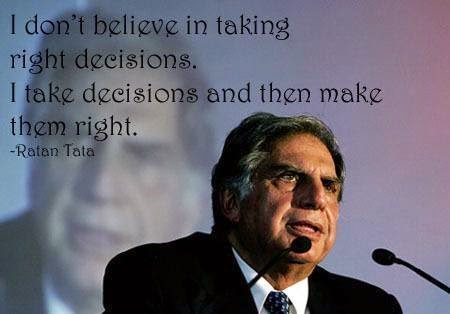
In the toughest field of business, where uncertainty at its peak, Ratan Tata is more concerned about making the 'decisions right' instead of focusing on the taking the right decisions. On the other hand, managing the uncertainty of the decisions make the individuals so nervous that they spend huge money and effort in taking 'right choices'. 

For instance, students of 10th class in India spend huge money on aptitude tests, counselors, websites of industries.  But, as we have found, aptitude tests are useless in identifying the 'hidden talent'.  But instead of spending time on choosing right college of graduation, using right learning strategies and developing the right traits,  they spend time with Counselors on getting information on jobs and industries. 


Uncertainty of facing the consequences of choice makes a person so nervous, that it is estimated that more than 35% use horoscopes to make big decisions. Most of the decisions are supposed to be in the arena of relationships. Astrology, subset of pyschic industry, is a big business. Market size of psychic industry is estimated to be about 2 billion US$. Individuals spend so much money on 'forecasting' because they want to feel in control of their future.

What do entrepreneurs have to learn from the choice-making conundrum? 

Individuals are over-occupied with making right choices because they want to be in control. But one can control 'uncertainty' only by making the decision right. For an entrepreneur, this is a very crucial learning.

Once an entrepreneur decides on running his own business, he has to find ways to make his 'decision' right, without getting his ego or emotions in the way.  If he spends time in taking a decision, it is only to 'assess' his own capability to commit to the decision.

An entrepreneur's success or failure is measured by the amount of energy and time he puts in making his decision of 'business model' work. I have often seen young entrepreneurs lose their track because they change their 'business models' midway just when the business is 'becoming ready to payback'. They often fail to 'understand their business model' and take actions which is not aligned with their chosen business model. For instead, they refuse to partner with someone to ensure that the right capability is brought on the table. Or they are worried about losing control on the company to get more funds which their business model demands. 

Saturday, September 20, 2014

Entrepreneurs often misdirect their efforts on building their abilities and traits

I met Lara last month. She is a second generation entrepreneur. She manages a unit started by her father. Whenever i talk to her, i find that she is attending one or other 'Positive psychology' seminars which have titles like " Discover your freedom", " Ask the Universe what you want", " Believe in yourself" and so on. She believes that she can do anything in her company, only if she can 'remove' all her bottlenecks, She belongs to a large joint family ( uncles, cousins) where most of the members are in the business. Surprisingly, all of them are attending one or other of such programs either to discover their true self, or 'manage his time well' or 'learn the art to delegate'. Later i discovered, that most of the attendees of such 'Positive psychology' programs are entrepreneurs, free lancers like consultants or doctors, or lone performers like actors who put all their efforts on developing their 'abilities' or honing their skills.


I asked Lara last month, " Will this fisherman catch more fish, if he fishes for more time?' Or ' Will he catch more fish, if he fishes with longer rod, or better fishing equipments?'. Lara was very quick in replying to me "That is ridiculous'. In fishing, the number of fishes you catch do not depend on how much time you fish, or with what equipments you fish. It depends on the 'surveying the terrain of fishing, assessing the nature of fishes available, and then getting the appropriate equipments and then putting on the right 'time and effort' to hook the fishes. Input abilities have to be aligned with the output 'requirements' to succeed in achieving one's goals.

If you understand the 'Enlight framework of Career Success', you will realise the futility of such misdirected efforts. Inputs or abilities are just one of the elements of success. Entrepreneurs will achieve their goals far more easily if they focus their efforts on producing the ' right outputs' instead of bettering their 'inputs' (abilities). Only when they determine their ' right outputs', they can focus on mobilising the 'abilities' that are required to produce the desired effort. If you read any story of a successful entrepreneur like Richard Branson or Jeff Bezos, you will find that their efforts are mainly directed on 'determining the output' they want to produce. 

On the other hand, most of the entrepreneurs are like Milind, who believe 24 by 7 effort will automatically produce desired result. It is like man trying to fish by constantly splashing the rod in the water and hoping that some fish will take the bait now or later. So why do entrepreneurs focus on 'abilities' instead of 'output'? I guess there are four reasons: 

1. Entrepreneurs believe that some action is more important than no action: When i told Lara about the importance of  determining the right output in her company, she said that 'it will take lot of desk-time to work it out'. Lara, like many entrepreneurs, is action-oriented individual. She believes that concerted action ( right or wrong), consistently taken over long period of time, will produce some result. Lara also had a word to justify her action-orientation. She believes that ' Analysis causes paralysis'. Due to this belief, she does not want to spend time on 'what to do'. 

2. Entrepreneurs wrongly believe that extraordinary abilities ( traits and skills) can automatically help them produce extraordinary results: If you have read biographies of any successful person who has produced bigger and huge outputs, you will realise the fallacy of this belief. For instance, if you read these stories of Narayan Murthy and Manmohan Singh,  you will realise that they produced huge outputs despite their weaknesses. Despite the evidence that perfect traits and skills do not produce extraordinary results, many entrepreneurs continue to strive in developing their abilities. 

3. Entrepreneurs are not aware of their 'key input ability', because they are not aware of the input framework. Input framework of success proposes that we need 3 key abilities to achieve our goals. Unable to assess the key inputs required to achieve desired goals, entrepreneurs cannot focus on important but invisible ability like conative trait and miss the opportunity to leverage their efforts.

4. Entrepreneurs lack the skill and patience of determining the right output: Everyone knows that pushing the right levers can result in big benefit. In a closed system, it is easier to identify these levers because correlation of one element with another element can be easily seen. For instance, 'Wrong material' leads to 'defects' in a production of an item. However, in an 'open industry system of competitors and suppliers' (system with more transparent boundaries) , it is very difficult to decipher cause-effect correlation. In an open system, it takes patience to set up experiments to understand the influence of identified 'variables'. It requires data to justify one's hypothesis. It requires 'ego-less' state to accept that one's hypothesis was wrong. Most of the entrepreneurs make the mistake of Rohit Sharma. Because they cannot figure out the 'right output' they prefer to take any action instead of finding the right action.

If you are a smart entrepreneur, do not spend your effort and time barking on wrong tree. Instead spend time on determining the right output.

Thursday, January 16, 2014

How entrepreneurs are misguided due to lack of Output framework

See this case of an entrepreneur, Milind.

Milind is a computer science graduate. He worked in a software industry for about 5 years. He was earning a pretty decent salary and had a job where he was moving in different countries. He was successful but unhappy with the job because he felt that there are too many 'constraints' in the job. 

So he resigned from the job to start his own unit in education. He started teaching maths and science to HSC students. That did not work. After one year, he found another idea: teaching engineering students to undertake difficult projects. This idea worked, but the idea was not sustainable because getting the job done was the primary responsibility of college professors. So colleges did not encourage outsiders to help their students. The idea was sound but did not possess easy marketing channel. Second year finished. His debts had increased over a period of 2 years. 

So he moved to selling workshops to schools after 2 years. He started working with schools on training of scientific concepts through workshops. This worked well. But he met another problem: he needed investment to make the new business model work. Debts had increased now. Milind himself is unsure of the returns of new investment. He does not know what to do. 

What would you advice Milind now?

Seeing through the lens of Enlight output framework


To succeed in life, we have to produce outputs. In an existing organisation, as we saw in the earlier case of Adi, the output system is designed by the organisation. When we work in an organisation, we have to 'fit' in the existing output system and ensure that we produce the desired performance within the 'constraints' of the system. Unable to negotiate these constraints, many individuals are tempted to think, "What if I design my own output system so that i do not face any constraints." Many entrepreneur stories are born with this desire.

As human beings, we dislike the constraints of an output system. Our dislike is understandable, but we are also ignorant of the knowledge of designing an output system. Infact, most of the budding entrepreneurs are not even aware of the concept of 'output system'. They think like Milind. They believe if they do x, y will get produced. And if y can be sold at a price higher than cost, they will earn profit. For them producing output is a very sequential process of tasks and activities.

Unfortunately, in the output system the efforts and its consequences are circular. For instance, if i teach a student better, i get new students because he talks to other students. Then new students help me to teach better. Consequences becomes the new cause in a circular system. But these relations also have time lag. If i teach a student this year in a class, i will get new students next year. Plus system is moving with irreversible time arrow. This means, that time is flowing in one direction. Until I get a new student next year, i have to 'sustain my efforts and investments' during that intervening time, so that i can take advantage of the new students next year. If Milind cannot sustain, he cannot benefit of the time cycle.

And more importantly, every system also has 'constraints'. The constraints of Milind's output systems are infact more 'deeper' and difficult to negotiate than Adi's organisational output system. For instance, Milind will find it more difficult to convince his customer than convincing his Boss. Now, if he sits back, he will appreciate that negotiating the constraints of his organisational output system was much easier than negotiating an entrepreneurial output system !

Output may not get converted to outcome - Big lesson of framework

Look at the Enlight framework diagram again. You will find that output and outcome is produced in two different systems. In an organisation, because salary is fixed, one will at least fetch some money (i.e. gain some outcome) whether one contributes reasonably to the 'output' in that month or not. But, for an entrepreneur, outcome is clearly delinked from output. Even when Milind delivers his training well to his students ( i.e he produces desired output), he may not earn enough 'money' until he finds enough number of students. Outcome is not guaranteed even after producing desired output. 

Until the entrepreneur aligns customer acquisition flow with delivery flow, he cannot earn money (produce outcome) from the business. This is called alignment of business model. Please check this example to understand why alignment is required to produce income. After three years of entrepreneurship, Milind is now realising that effort is not directly related with outcome. That is why he is unsure about making the new investment. Three years back, he would have invested money without blinking his eye.

Every output system has its own constraints - Another lesson of framework 

I hope you will now appreciate the art of designing output system. I hope you will also appreciate that every output system has its own constraints. You will also appreciate that an 'open system' of an entrepreneur has more constraints than a 'bounded system' in an organisation. Although starting your own unit may give you a feeling of 'constraint-free' work ( work without a boss), you are infact going into a system where constraints are even more powerful and deeper. So when a professional is leaving an organisation to start his own entrepreneurial unit, i coach him to negotiate ' larger number of constraints' !!

Infact the entrepreneur must learn the basic rule of an output system : If the constraints are more in the output system, the probability of earning money from that system increases, because systems with more constraints have less competitors. You will appreciate this only if you understand Second law of Success, which is Enlight framework.

An entrepreneur, in other words, must understand and use the Output framework even better than a corporate professional has.

If you want to become an entrepreneur, are you ready to understand the Output framework of Enlight? 

Saturday, December 14, 2013

Some entrepreneurs learn the art of entrepreneurship just through experience


Here is the video of an entrepreneur, Ryland Goldman, who is just 7 years old. He gets up early and bakes foods like biscotti, muffins and brownies. He buys coffee and juices from other sources, sets everything out on a folding table near the sidewalk in front of his school. On some days, he earns more than $100. He donates 50% of his net revenue to his school technology fund.

Last week, i visited a fund, which gives money to young entrepreneurs from small towns. One of the entrepreneur was making Chapatis for school and college canteen with his mother and family, and had approached the fund for financing roti making machine. Another entrepreneur,who was granted funds earlier, was making wax candles in a house in a tribal village. Another was making hats for Hotel Chefs in Mumbai's chawls. Another was making masalas and spices and selling it under his own brand. Another woman was making sweet packs of paper. The variety of entrepreneurship is astounding

In short entrepreneurship is flourishing. In India, as they say, the single biggest pool of employed women and men are these self-made entrepreneurs. These entrepreneurs have learnt the art of entrepreneurship by 'jumping in the water' without learing to swim. They seem to grasp the business model automatically. 

For instance the revenue part of business model. Like Rylan, they automatically sense where their customers are, what do they want, how much are they willing to pay. It was the same with that Chapati making entrepreneur. He knows his customers are company canteens, college canteens, and even hotels who want chapatis not for serving, but for feeding their staff. They also learn to align the delivery model. For instance, the chapati making entrepreneur exactly knew the cost of making the chapati to the individual elements: how much chapatis he makes from 1 kg of wheat, how much gas he needs to make 100 chapatis, how much oil he requires to keep the chapatis soft and so on. So when we talked about using a roti making machine, we knew what is the additional cost of making the roti and how much will he have to sell if he still has to earn money.

On the other hand, i also teach a short course of 'entrepreneurship' to ITI students ( 12 session course of 1 and half hour) who pass their ITI from the trade of plumbing, electrician, AC mechanic, or Four wheeler servicing. They have the right mindset of the entrepreneur, also gather the skill set of the trade, but lack the principles of entrepreneurship. They typically gain this understanding by working with someone and start their own self-owned enterprises. Some succeed and some fail. I meet many such entrepreneurs during the course of my coaching. 

I either coach some of these hard working enthusiastic individuals to think like an entrepreneur, or i hone the skills some of these entrepreneurs by helping them articulate the learnt principles. In both the cases, i gain, because i take over some part of their energy, enthusiasm and hope which is contagious. 

Saturday, November 2, 2013

True entrepreneurs are similar to Artists

Artists don't make paintings. Authors don't write books. Designers don't design logos. They extract meaning from something  that is banal. They bring a new view and make us see something meaningful in our ordinary acts. They make meaningful experiences happen. @


Entrepreneurs do not manufacture products. Entrepreneurs do not run their companies to make money. Entrepreneurs do not solve problems of human mankind. Entrepreneurs add value where there is none. Entrepreneurs find a new meaning in an obscure product or business and lend their own meaning converting ordinary products and businesses into extra-ordinary, like Richard Branson, Steve Jobs or Narayan Murthy.  

If entrepreneurs were only doing business to make money, they would be working in jobs. Why would they risk anything more? They run their own companies because they are like artists, lending their own meaning to life. We may not agree with their meaning, or may not even like the commercialisation of some value they bring, but their unique contribution to our lives is their ability to show a ' meaningful view' that we cannot see on our own. 

We see business as a commercially driven activity where money, customers and market rule. But even amidst this commercial activity, these entrepreneurs bring in something  that we cherish and value in life. Observe these entrepreneurs bringing in completely different set of meaning to their business ventures. Steve Jobs brought in design, Narayan Murthy brought in values in business while Ricardo Semler brought in a new way of 'democratizing business without managers' in the most difficult economy of Brazil.

After they do it , we wonder how we missed it. When Richard Sears made his chain of retail stores, no one knew that it could spawn a new way of shopping. Or when Ray Kroc, at the age of 52, started Mcdonalds, we thought it is so simple to do it.  Or when Larry Page & Sergie Brin started Google with no revenue model for their technically excellent 'search engine', we thought that business cannot be done with technical excellence alone.

For every famous entrepreneur we hear, we also know many others who are doing the same at a smaller scale and size. We do not hear about them in newspapers, but i meet plenty of them in the towns and small cities. Whatever their scale or size, every entrepreneur, if he is true to his being, brings this meaning to an otherwise mundane activity of business. Like Mumbai based dabbawallas helping normal man eat their home food at a rate that was not affordable. Like an entrepreneur who teaches a graduate class to pass the toughest civil services exam with a success rate of 80%. Or a tyre puncture repairer, who repairs a tyre and gives a guarantee after his repair. Or an entrepreneur who manages websites of schools on build and operate basis. Or a corporate trainer who synthesises spirituality with business activities and lends them different meaning. 

Salute to this rare breed of human beings, who like artists, are rare. Like artists, they flow against the current. And follow their convictions even when the society around them tells that they are mistaken. Salute to true entrepreneurs.

Both entrepreneurs and artists learn from each other

If one sees the similarity between entrepreneurs and artists, Jeffrey Davis suggests that both entrepreneurs and artists can learn a lot from each other. 

Business people can learn from artists and authors how to think differently about what they make and how to experience the meaning of life. While artists can learn from entrepreneurs how to 'sell' their work and make money from their work without deriding everything 'commercial'. 

@ Jeffry Davis in his article: Pivot your creative process and business. 

Tuesday, September 10, 2013

Give me a long enough lever, and I can move the entire world

Archimedes in writing to King Heiro, made the above statement.


If an entrepreneur were to ask for such a lever, what would be that lever? The lever would be called Conative traits. These traits enable us to find our passion, discover purpose of our life or find meaning of life that enables us to connect with our work differently. Why is this important for an entrepreneur in today's century? To answer this question, we will have to understand the second law of career success

First law of career success on inputs states that
      Developing Talent = Using A
  • A stands for using a single ability or skill or even trait like passion or willpower. This list of abilities and traits will differ depending on which book you are reading 
Second law of success on Inputs states that
     Developing minimum Talent = Using 'CA + CAT + COT' .( these are minimum abilities required to ensure that you will not fail. It does not ensure success)
  •  CA Stands for Cognitive abilities, CAT stands for character traits like self regulation and creativity, and COT stands for conative traits like purpose and passion. All three are required to find and nurture minimum your talent. And synergising these three qualities is more important. Not just making them 1+1+1 =3, but making it 1+1+1 = 5.
Please see the earlier blog to understand why all three qualities are required  to excel in your life.

Why conative traits act like a lever for an entrepreneur? 

As we have seen in this blog, conative traits are important for a corporate professional mainly to take quick work-related decisions. But for an entrepreneur, conative traits act like a lever by which they can change the entire world.

Conative traits enable an entrepreneur to go beyond 'money' and 'profits'. By finding the meaning of 'work' in his life, an entrepreneur can express his desire to contribute to the lives of others, either by introducing something new that improves the quality of their lives or by showing people that something thought to be impossible is in fact possible. Steve Job did by using his passion of design. Narayan Murthy did this by finding different meaning of 'capitalism'.

Anthony Tjan trying to find the common qualities of billionaires believes that it is their purpose that defines them. He believes that "purpose is neither something soft nor something overly lofty. Instead, purpose is the bigger why of a business". He has categorised purpose into three categories: a>Making the world more beautiful. b> Making the world more fun and c> Making the world more efficient and smart. Please read the above link to see his examples of entrepreneurs and how they are using these three different type of purposes.

Worse still, if entrepreneurs fail to develop conative traits, they fall in the money trap. Money, instead of becoming means, becomes an end. Money, instead of enabling experimentation and exploration, ties them to tested and obsolete ways of doing business. All the joy is sucked out of the work, and entrepreneur starts seeing work as drudgery. The very purpose of entrepreneurship is put at question.

Conative traits, on the other hand, help you see beyond money and make your choices without thinking of money. There are various possibilities. For instance, you will do something what Vinay did. Vinay focused on nurturing his passion. This enabled him to take several counterintuitive decisions like partnering with others to share work, without worrying about sharing the profits of his innovative product development. Or, like Kanpreet, you will be able to mix and match your abilities in the way that suits your development of talent.

Conclusion

Finding meaning or purpose of life is therefore not an empty exercise of discussions for an entrepreneur. For him, it is way of increasing his options and growing himself and his enterprise to unthinkable heights. If you are entrepreneur, you will need to learn the tricks of developing your conative traits. Please use some of the tricks that were mentioned in this blog. See movies. Read interesting literature. There is no need to read serious books in philosophy, ethics or aesthetics. Read biographies. Read the journey of other individuals like Bill Watterson. Engage with people who know more than you on this subject. And most importantly; find a mentor or coach who can show you the path. Because, with conative traits, you can make a big difference to the world. 

Sunday, August 11, 2013

How can you learn from experience of other entrepreneurs?

Today, we are going to understand the Experience rule of Second law of success. It states : To excel in life, we must learn faster than our own experience alone can teach. If we are forced to learn from our own experience, then we are doing catch-up all the time. We have to wait for failures to happen, because we are poor at learning from our own successes. We therefore have to find a way to learn from other's experience. 

How can we learn from others experience? It requires a mind of a detective who is trying to find the keys to unlock the power of excellence. Because an entrepreneur has to unlock the key of entrepreneurial excellence, he has to learn from the experience of other entrepreneurs. To learn from experiences of other entrepreneurs, he must go through these four steps: Adopt an angle or a view, dig deeper in understanding the specific path of someone else's experience from that viewpoint, find what he can adapt (instead of adopt), and then dig further to find how to adapt.

Let us see understand these steps in more details by observing work-life path of Pradeep Lokhande, a successful entrepreneur who converted a business idea into an interesting company, Rural Relations. For more information, see this background of his venture in this article by Dileep Padgaonkar. From this article and his website, you will perhaps observe the following data:

Pradeep Lokhande (PL) has come from a small town, Wai, near Pune. He did his graduation and then MBA in Pune. He worked for Johnson and Johnson as a sales representative for just two years. And then he decided to use his 'rural connection' to tap rural market for FMCG companies. His journey of identifying the right villages - population of 2000 to 10000 - has been described. Wiith his innovative marketing techniques — such as providing height charts to schools and posters listing tips on health and hygiene to panchayat offices — and by recruiting young boys and girls from the village itself to reach out to potential customers, he found a business model that helped him generate a sustainable revenue.

What can you learn from this PL's story of an entrepreneur? 

You will learn that PL has innovatively used his rural connections to lead FMCG companies to sell their products in this untapped rural market. You may realise for the first time, that 'rural market' can be tapped. This is just data. No useful learning happens unless you take an angle.

Angle of  'how to discover a business model' for a new business idea 

Angle in a camera is like clicking a 'hill' from a specific view. Only when one takes an angle, one can learn. In this case, when you can take an angle " What steps did PL take to convert his idea in a business model?", you are ready to learn.

However, to answer this question, you will need far more information from PL than what is available above. Here i can help you. I had listened to PL's interview in a program in Nashik. For instance, after listening to his interview, i could observe five distinct steps in his journey of converting his idea into a business proposition: 
  • Step 1: PL left J&J business in 2 years. But he did not start this RURAL RELATIONS immediately. Instead he started his C&F agency with a friend which he ran for 3/4 years. In other words his idea of tapping the rural market must have come in this 3/4 years, while doing 'field work' of going to retailers and understanding the problems of selling it in rural areas, as a C&F distributor. 
  • Step 2. When PL decided to tap the rural market, he wrote many self-paid postcards asking people in villages ( like sarpanch and others) to send details like number of shops or brands sold in the village. This took him several failed attempts and consumed his 2 years or so. 
  • Step 3.  With his initial data on some 100 villages in Pune district ( or it could be some other districts also), PL approached a FMCG company, which he perhaps knew from his role of C&F distributor. That company gave him some work ( i am not aware if that work was paid or unpaid !) 
  • Step 4. With the feedback from step 3, PL built a business proposition and approached a big FMCG company, HUL( Hindustan Unilever). He promised HUL that he will place HUL's  product promotional material ( product hampers and cutouts etc)  in his select list of identified villages. With this promotion, the sale of HUL products will increase. His value offering to HUL was ' By investing in placing your promotional material in the right village and place, your sales will increase'
  • Step 5: This generated 'good enough revenue' increase for HUL which enabled PL to justify the cost he may be charging to deliver the promised value. PL found his business model that will deliver the promised value
Until you know the challenges involved from step 2 to step 5 in PL's experience, you cannot use PL's experience to launch your own business idea. But , after understanding these steps, you are ready to ask some more questions to PL to fill the details. Only when full picture is available, you are ready to adapt PL's steps to convert an idea into a business model. Without any understanding of challenges involved in the steps and the duration, many entrepreneurs just jump with a new product idea with 'unrealistic' expectations and falter. You can avoid this failure, if you take the effort to fill the gaps in PL's experience, and learn.  

On the other hand, if a would-be entrepreneur is meeting PL for an interview, his angle may be 'How do i get a business idea'. He will find his answer in Step 1. He will ask more questions to PL on step 1 to find out how PL got his idea from his customers, vendors and competitors in those 3 years. He will understand why PL spend 3/4 years in understanding the market, before entering the market. He will avoid jumping in a new venture without understanding the market, and learn from PL's experience.

Summary

When you want to learn from others experiences, you must therefore act like a detective who is meticulously finding needle in the haystack in step by step manner:
  • Determine the angle of learning- In the above example, we explored only one angle of a existing entrepreneur: the angle of 'discovering a business model' for a new idea.
  • Find questions that will be useful to ask;  This is the most important step that is ignored. Thomas Edison used to say that ' Half the problem is solved when you ask the right question'. For an entrepreneur, who wants to ask questions to PL on 'finding a business model', he must first read on internet the typical questions entrepreneurs face, weigh them visavis his experience, and decide on the 'questions' that must be asked. 
  • Find the right person to ask the question : We often ask our questions to the 'available' person, not the right person. Sometimes you are asking the right question to a wrong entrepreneur, or asking a wrong question to a right entrepreneur. 
  • Find what you can adapt from the answers, and dig deeper until you find the right answers of how to adapt. 
Now you will  understand and appreciate the mechanics of learning from others experiences. If you do not understand these four steps from learning from others experience, your learnings ( Work hard, or set a goal) are so superficial and generic they are practically useless. When you fail to learn anything useful, you stop asking questions to another entrepreneur. You think that it is of no use. And once you stop asking questions, you learning completely stops. You have set yourself for 'eventual' failure !

Conclusion

Learning happens only when a clear angle is taken, because angle enables one to generate the right questions to ask. If, as an entrepreneur, you are trying to understand, how to delegate, that angle will help you generate the right questions ( from your quick research) to ask another entrepreneur and become 'better at delegating'. If you are trying to find ways to increase your business size, you will generate the right questions to ask PL on how he increased his market from 1 state to 8 states. If you are trying to attract good employees in your company, you will generate the right questions to ask PL on how he attracted the right talent to work in the village ( which is perhaps most difficult !) and learn from his experience.

Once the right question is framed, the second important bottleneck in learning is finding the right person to ask that question. Right person is the person who has gone through that experience and is willing to talk. More often, that not, entrepreneurs are action-oriented individuals. They are unable to 'articulate' their thoughts.These entrepreneurs, although rich with experience, cannot sometimes transfer their knowledge. On the other hand, business consultants are the right persons to articulate, but do not have the rich experience of an entrepreneur. Learning from other's experience therefore also involves finding the right person or persons to ask the questions ! 

Thursday, July 11, 2013

Three mistaken stereoptypes of an entrepreneur

Daniel Isenbergy, author of Worthless, Impossible and Stupid has listed down three interesting and wrong stereoptypes of an entrepreneurs.

1. Entrepreneur are not always innovative

The author has given a very nice and crisp definition of what entrepreneur does. He says that " An entrepreneur creates value. He creates a value that is recognised by the market." Sometimes, to create a value, he has to innovate. But, most of the time, he need not innovate.

I have been meeting entrepreneurs and coaching them from last 3-5 years. I was surprised to notice that most of the entrepreneurs i have met are not innovative. They sometimes start the venture with a very novel idea. But once that idea is established, they are just in the 'routine' of doing the same 'business' over and over. They forget that money was a side effect of their desire to do something novel. Instead of making money work for them, they start worrying about 'losing' the money. Once this happens, the zing in their life goes. And they become a business man ! You can see this people in entertainment field. There are very few like Aamir khan, or Abhay Deol, or Imtiaz Ali who never forget that 'Money is the side effect of business'.

2. Entrepreneurs are not always experts

With the advent of of VC industry, there are many entrepreneurs who start a venture because they can create value. We seem to have forgotten this. Steve Jobs was an entrepreneur who did not design his first computer, he was a person who could dare to create value where none could see. We have forgotten that this hugely daring and optimist breed, which Daniel Kahneman says are the lucky people we have in our society, is becoming extinct.

The author notes that  50% of the entrepreneurs started their ventures in an area they knew nothing about. He shares a very interesting insight about the 'expertise of entrepreneur'. He says that 'Knowing something too well can come in the way of being an entrepreneur'. And when you meet big experts who are researchers and professors you realise how true is the author ! So if you are an entrepreneur, do not pursue expertise in one area of focus !

3. Entrepreneurs need not be young

Today, with advent of VC and intrapreneurship in companies, you will find entrepreneurs starting their first venture even in late 30's.

But young entrepreneurs are more to be seen, because they have less to lose. Their ignorance of market reality paradoxically makes it easier for them to take the risk. On the other hand, their lack of market common sense can make them prone to failure.

For instance, i met a daring entrepreneur , Unmul, who at the age of 19 has started coaching classes for 12th science students. The classes ran well in a small town. So he decided to come to a large town and launched the same coaching class, not realising the customer differences between small place and big town, not understanding the difficulties of transferring the local reputation to the new town, and without understanding the changes required in business model. The new business naturally went into lot of trouble !

Actually, for young entrepreneurs like Unmul, there is a easy method to avoid this mistake. If they can find a mentor who can help him see these pitfalls, they can channelise their energies far more productively. But in the desire of not wanting to meet people who 'object' to them, they also miss the pearls of wisdom. 

Thursday, June 6, 2013

Do strategic and execution audit of your business

In a family managed business ( family managed business can range from 10 crores to 500 crores), it is often very important to get an objective perspective of the business so that the right priorities are set.

As the processes and systems in these companies are not well set, these companies often lack the wherewithal to 'scale up' the business. More often that not, the 'weak chain in the link' is not the execution, but the strategy that has not been planned properly. And sometimes, the issue is not the strategy nor the execution, but the divergent directions of family representatives that often pull the company resources in different directions.

A strategic audit of such a business, competently and objectively done, often guides entrepreneurs in providing directions in four areas that can make a difference of success and failure for the business:

1. Is the strategy of the company right ?

Often the business, when it commences, has a set of competitors, regulations, substitutes and customer segment to deal with. But as the industry grows and matures, the strategy has to be modified radically, or just  tinkered a bit. This is true for all types of business, but value propositions in some businesses require more frequent reviews. For instance, businesses in service sector, retail sector, like software require frequent reviews because these businesses face lot more upheavals than the others.

Sometimes the strategy requires a review, because a company is caught in a business that is becoming less attractive every day. Here the company should quickly review its strategy and alter the direction, if necessary. Sometimes, the company also does this review to identify, what is called the sweet spots in the businesses that can multiply the company's results in geometric proportion. For example take this example of construction business. 

2. Is the business model of the company right?

Having a right strategy is not enough to run a business. One should also have the right business model to succeed. Business model, as we have discussed earlier, is the right combination of nine components ( 4 revenue, 4 inputs and one value proposition) that are appropriate for the company's size and ambitions. More often that not, entrepreneurs tinker only with one component which often does not produce any result because these nine components are correlated with each other.

3. Are the resources appropriately placed in the different sections of the business?

In a family managed business resource allocation - of money, key people, and time - is often a bone of contention as different owners in the family have different viewpoints of a business and therefore tend to direct companies in different direction, sometimes directly in conflict with each other. Understanding the strategy and business model enables family owners to align themselves with each other without interpersonal conflicts and egos. This alignment enables family managed business to unlock its true potential.

4. Is the company executing the strategy appropriately?

This review should naturally be done, only after one is certain that strategy is right for the organisation. Otherwise a company may support a wrong strategy, and despite executing it well, may still fail.

This execution review will point out the gaps in the organisation that are causing the organisation to produce less-than-desired results. The gap could be in processes or systems, or could be the professional capacity of key people, or in the 'alignment' of people with the 'direction' of the company. These gap identification enables the company to take appropriate actions.

Finding the right review consultant is a big bottleneck

A good strategic and execution audit of business can help a business quadruple its revenue and profits. I have also observed, that although the need of review is felt by the business , they cannot find the right consultng agency which is competent, cost-effective and reliable.

Finding the right "review" consultant for a small and large business is tough because of two factors. One, large consulting companies, who have the expertise, are very expensive to hire. Morever, these large consulting firms also are 'unaware' of the 'dynamics of small companies' because of which their recommendations are not practical and doable. On the other hand, finding small consulting firm is troublesome, because the small consulting firms lack the knowledge base although they may have the experience of dealing with small business.

Of course, with the right help and guidance, finding the right review  consultant is possible. 

Monday, May 6, 2013

Is your business model sustainable?

Here is a very good video of a business model of Nespresso, a subsidiary of Nestle, selling coffee at a premium rates. It is a very good 'real-life' example of how different component of business have to be 'tied' together to create a viable and profitable business model. Individual components such as - revenue stream, channels, or value proposition - do not matter much; what matters is how they are 'integrated' together in one piece.

Interestingly, the nine individual components are bifurcated into two separate streams:
  • 4 Revenue side components that includes revenue stream, type of customer relationships( new or repeating), distribution channels and customer segments and another is 
  • 4 Input Resources components ( or what we earlier called servicing side of business in an earlier blog) which includes key activities of the business, key resources to do those activities, key partners to help you do deliver the business promise and the resulting cost structure and 
  • Component of Value Proposition which ties Revenue with Resource  ( i.e costs) components together and determines the profitability of the business 
In an earlier blog, we had seen how the clash of investment of time, money and resource between acquiring a customer and servicing the customer ( between the revenue and input components, in other language) can make a business model unsustainable. 

Advantage of a putting the business model on one page

Once you put your business model on one page like Nespresso, then you can see how individual components correlate, how the correlation is affecting both sides - revenues and resources - simultaneously, and what to do to increase the profits, or deepen the customer relationships. It is a like snap shot of the entire business that can help you find the best available leverage in your business.

Have you mapped the business model of your organisation on one page? If you have not, it is time you do it. 

Sunday, April 14, 2013

Four skills that entrepreneurs lack

I recently saw a study of serial entrepreneurs. These entrepreneurs had started multiple businesses and experienced both success and failure. It is interesting because the survey also compared the characteristics of entrepreneurs with a control group.

The survey found that entrepreneurs possess five skill.They excel in five soft skills and fare in them much better than the control group of corporate professionals. These skills, by their nature, develop slowly over time. These are the five skills:

1. Persuasion: Persuasion for this study was defined as the ability to persuade others to join the mission. So the presence of this skill is not surprising.
2. Leadership: Leadership was defined as having a compelling vision for the future.
3. Personal Accountability: has been defined as willingness to take responsibility for personal actions.
4. Goal orientation: in this study was defined as focusing all the efforts on a goal or objective.
5. Interpersonal skills: They include communicating, building rapport, and relating well to people from different backgrounds and communication styles

But the surprising part of this survey is the lack of four skills that entrepreneurs do not possess. Here are the four skills that entrepreneurs lack.

1. Lack of Empathy: This is surprising because entrepreneurs typically solve problems of people when they come out with their new ideas. This suggests that entrepreneurs have empathy at an intellectual level. They expect returns from understanding others problems, which people with empathy typically do not expect.
2. Inability to manage themselves: This is not so surprising, because entrepreneurs are so busy managing their enterprises that they do not have time to manage themselves.
3. Inability to plan and organise:  Lack of this skill is also perhaps due to the above reason. They are unable to manage their calendar, organise their meetings, and keep their office neat and tidy.
4. Lack of capacity in Analytical Problem solving: Lack of this skill is surprising. But hindsight  suggests that this may be due to their 'action orientation' and wanting to 'get things done' yesterday. They constantly hear others who block their ideas and therefore they perhaps tend to dislike analytical problem solving that will slow down their decision-making

This survey also suggested that good entrepreneurs somehow find a way to negotiate the lack of above skills. For instance, entrepreneurs find someone to fill the gaps in second and third skill by having someone to take care of their time management and meetings. Similarly, good entrepreneurs find someone to manage their employees - either their friend or a loyal employee - who perhaps has more empathy than them so that they can retain their employees. To compensate for their inability to solve problems analytically, successful Entrepreneurs find partners who can execute their strategy well.

As an entrepreneur, do you lack any of this skill? And what are you doing to compensate for it?. 

Tuesday, March 12, 2013

Diagnostic thinking is critical for entrepreneurs

Please see this interesting video of Ranjay Gulati, Harvard Professor, on the importance of diagnostic thinking. He has given a brilliant example of how doctors can get misled by 'problem symptom' and rush to a 'solution', instead of taking a pause and 'diagnosing' what could be the problem. As entrepreneurs are highly action oriented people, they are also prone to this 'jumping' from problem to solution.

When entrepreneurs jump from problem to solution, they make three mistakes:
  1. Do not observe all the 'variables' that are also causing the symptom. For instance, when an employee is not able to 'do the work as per the instruction', we simply assume that 'employee is tardy' or 'non committed' or simply ' avoiding work'. We do not wait and wonder if we gave incomplete instruction, or we forgot that the employee does not understand 'the technical word' which we used while giving the instruction.
  2. Use the 'available' evidence, instead of using the 'right evidence' : Daniel Kahneman, the Noble Prize winning psychologist, calls it the effect of Type 1 fast and unconscious mind. For instance, if the employee has made a similar mistake in the past of not following the given instructions, we quickly use the 'available evidence' and label the employee as 'lazy', ignoring the evidence that 'he had been given too many actions to be taken without any guidance of prioritising them'
  3. Hasty actions cause more unintended consequences, further confusing the 'problem symptom': Our past actions contribute to today's symptoms. But we forget this variable in the heat of the unfolding events. For instance, because we 'scolded the employee' infront of other employees for his past mistake, the employee felt 'victimised' for the mistake he tried to avoid. So now, he is already thinking, " If my best actions cannot help satisfy my boss, what is the use of putting your best'? You have unknowingly sown the seed of 'carelessness' in the employee and now expect him to 'overcome' the hurdle and do something different for you. 
Here are three ideas to avoid this natural tendency to jump from problem to solution, and instead do a diagnosis before taking up an action:

  • Take care of the initial interactions with a new employee, vendor or customer: Because of 'unintended consequences of past events', initial interactions are critical in guiding our actions and solutions. Therefore, in the initial stages of a long relationship, use the pause button a lot more to collect evidence before jumping to any conclusion. This will enable you to avoid the mistakes of 'accumulated past'
  • Always take a pause in an interaction where the other person has 'low unequal power': Subordinates, children, ( and even spouse) have low power in any event. In all such interactions, we tend to oversimplify the event, look at the available evidence, and swiftly jump to the conclusion. Push a pause button and do a diagnosis before coming to a solution in such unequal-power interactions.
  • Become aware of your heuristics ( our thumb rules) while interacting with people: We all have heuristics like 'Labour wants more money for less work', or 'Customers want everything free', or 'Late employees are not committed' or 'People who cannot do a good job are not willing to take a responsibility' and so on. We use these heuristics to form a quick conclusion and become blind to notice other evidence that is contrary to the heuristics. 
What are you doing to ensure that you do not jump from problem to solution?


Friday, October 12, 2012

Partnering is toughest for entrepreneurs

 Vaitesh is a very good software programmer with more than 5 year experience. He worked with a friend for developing a software product in billing services, earned good money from selling it to a customer, and is trying to sell it to other customers. He met Unmukt, a 7 year experienced professional, who had started his company in services. Unmukt had some background in software programming. Unmukt and Vaitesh met. Their common friend suggested that they could work together and create a 'bigger product'. Vaitesh however rejected the idea saying that his product framework is 'very innovative' and requires a 'different approach' to selling. 

You will find many individuals like Vaitesh. On the surface, it seems that the root cause of not collaborating with a partner is only inside Vaitesh. But i have observed many entrepreneurs, like Vaitesh, refuse to partner with others primarily due to four reasons:

1. Fear of getting swindled by others: This fear is genuine, but when one reacts to this fear, one's emotion is using him. If one things objectively however, one can take several preventive and corrective actions to negotiate this fear. Preventive actions like knowing the person fully before committing to a partnership, increasing the stake in the partnership in a step-wise manner instead of one-shot, and other legal actions are possible. One can also take corrective precautions ( legal and otherwise) to reduce the damage that may happen when all the other possibilities fail.

2. Ignorance of Contribution of different experts to the success of a entrepreneurial unit: This requires understanding the value chain of a product, the business model of a product. Without understanding the value chain, Vaitesh cannot appreciate the importance of 'Sales or Marketing' in the business model. In 'developing a software product business', Vaitesh does not understanding the importance of sales function. This business model' ignorance causes many entrepreneurs to 'delay' their success, and in worst cases, also trigger their failure. Vaitesh is one example.

3. Misunderstanding of what one can learn through experience: This misunderstanding stems from the ignorance of how people develop knowledge and skills in any area. When they develop a technical product, they understand the value of 'technical expertise'. But when someone is selling a product, they think that 'selling' is just going to customers, suavely talking to them, and making them buy the product with promises and words that may or may not be fulfilled. Many entrepreneurs believe that 'selling skill' can be developed by anyone with some application of patience and practice. Sometimes, they themselves try to learn it.  Sometimes, they try to hire some smart people and expect that 'sales' will zoom, often ignoring the complexities of customer.

Misunderstanding the development of sales and marketing skill is perhaps one of the biggest reasons of entrepreneurial failures. Vaitesh is not alone in having this misunderstanding. I have seen experienced entrepreneurs who are novices in 'sales and marketing' skills'. Not only their progress is blocked due to this ignorance, but even their survival can get threatened sometimes !

4. Inability to talk and reason with strong willed people: When strong willed people work together, they naturally have differences. Individuals often find it very difficult to sort out these conflicts and therefore end avoiding each other. Instead of using the differences to surface the different underlying assumptions of the conflict, entrepreneurs tend to suppress them. Instead of benefiting from the complementary approaches two individuals bring, entrepreneurs seek consensus sacrificing the quality of decision making. Instead of using conflicts to learn different viewpoints, they seek individuals which have same viewpoints that decrease their chances of success. Entrepreneurs often do not learn this skill of using diversity and instead seek homogeneity which, although looks good on the surface, does not help in a deeper way.

Summary

Are you also avoiding partnering in your business because of the above four reasons? If you are, it is time to review your thoughts and do it differently. Remember, in every business that has produced stupendous results, it was the partnership that took it to different heights. It has been proved beyond doubt that partnerships have created more and better businesses than single-owner businesses. Be it a partnership of Steve Jobs and Steve Woznaik, or the partnerships in Infosys, or the partnership of Hewlett and Packard for HP, partnerships flourish better mainly because of last reason: the diversity function. 

Tuesday, September 25, 2012

Funding Help for entrepreneurs

Once you have a business model that is scalable, then it is time to find funders.Venture funds and angel funders typically help an entrepreneur in providing funds at this stage. This method of funding is very prevalent in western countries, and has come into vogue with the popularity of internet. However today, venture funds are also popular in more established sectors like Manufacturing and agriculture.

Unlike bankers, they do not require any security of land and assets, but they do a thorough review of proposal and promoters before funding. Bankers are useful when you have a good asset base, but these funders are useful when your asset base is not as strong, such as  in service companies. And more importantly, these funders also act as Mentors and give you access to their network and knowledge.

Why do they fund small units? They share the risk with you and therefore ask for a equity share in your company. They get their return when your unit becomes large and its market value has increased. Either they sell their equity stake to another investor, or wait for public issue to monetise their investment. Because they ask for equity stake, earlier you ask for funds, higher is the stake they ask. Conversely, later you ask, lower is the stake they will ask.

You will find two types of funders.One is a Fund Manager who has collected the money from the investors, and another are the investor members whom you have to approach directly.

1. Getting funds from Investor members directly

In this model, you have to give your proposal to a committee of one of these member networks. This committee short lists the proposal and then informs the members. Each member then takes an individual call on whether he or she wants to invest. Individual investment is about 50 lakhs, while total investment could be in the range of 2-3 crores. Because the cost of managing an investment is high, they will like to invest at least 2-3 crores. You will find it very difficult to interest them if your money requirement is lower than that. Three large networks of members are
3. Getting funds from Fund managers

In this model, corpus is created by getting money for high network individuals. Many such funds are available. As each fund is created for funding specific type of companies, such as in agriculture or in internet, it is important to find if the fund you are talking to has the mandate to fund your type of products.

For instance, Nexus Venture Partners funds, funds technology and internet companies, while Matrix Partners India has been funding internet and mobile sectors.  Seedfund funds, the oldest fund, provides funds to different type of companies, with as low as 50 Lakh to an entrepreneur.Today, numerous funds are available for funding in education, health sector, and agriculture. So if your unit belongs to one of these sectors, you will have many options to search money. Google for the sector, and you will get a list. After that, talk with someone who has used that fund, and you will get real information.

On the other hand, if you need help, write to me on my gmail id. I shall be able to guide you to the right consultants who work in this field.

Friday, September 14, 2012

Managing customer acquisition requires different type of thinking

In the last blog, we say how the dynamic interaction of two loops - customer acquisition and customer servicing - affects the survival and growth of a new unit. Here we will understand the uniquely different challenges of one loop, that of customer acquisition, and how we unknowingly create our own difficulties by using same 'type' of thinking that is useful in dealing with other loop of Customer servicing.

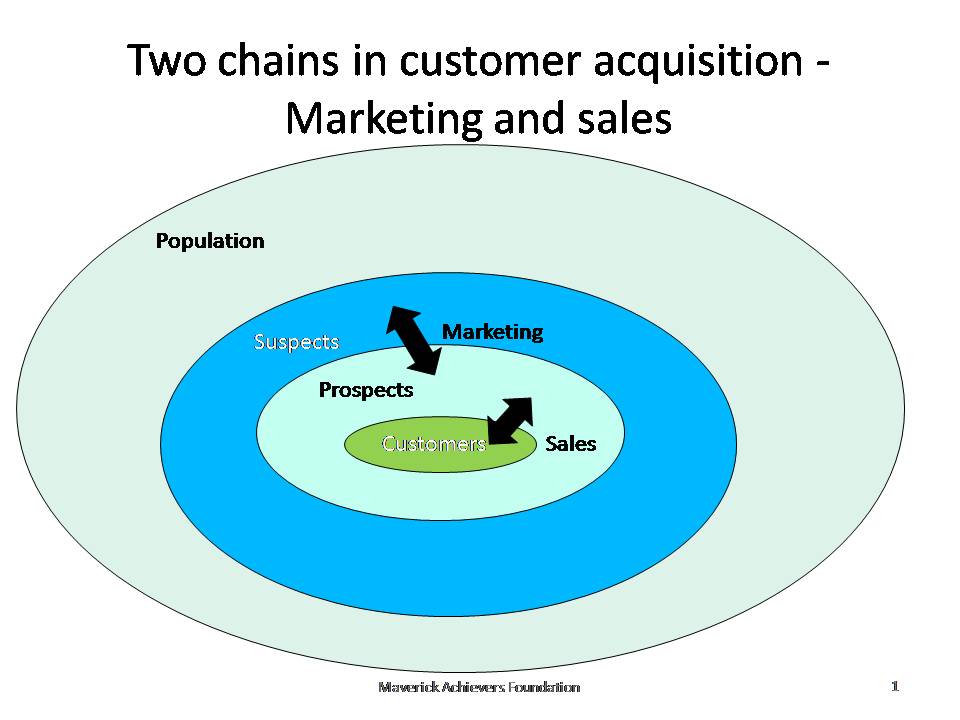
Two chains in customer acquisition loop

Many entrepreneurs overlook the fact that customer acquisition loop consists of two chains: Marketing (which converts suspects into prospects so that they come to the doorstep) and Sales ( which converts the prospects at the doorstep into a customer). Some entrepreneurs see these two conversions as one, and therefore take wrong actions.

Marketing chain

If Tata Motors is targeting families above incomes above 12 lakhs pa in the population, Tata motors will give  advertisements in the newspaper, sponsor programs for families, or put banner on the roads to convert these suspects ( the families of incomes above 12 Lpa) into prospects who want to buy Tata Manza. These 'marketing' activities allows an entrepreneur to convert their targeted suspects into a possible prospect. However, this marketing system has many holes. Because of these holes, unexpected events can suddenly happen and can break the cause>effect relationship. For instance, if the families of 12 Lpa do not happen to read the advertisement in newspaper for some reason,Tata Motors will not be able to get enough prospects after giving the advertisement.


Sales chain

Sales on the other hand has a relatively less transparent ( less holes) boundary. Because of this, an entrepreneur can predict the relationship between cause and effect with more assurance. Tata Motors, for instance, can hope to convert the prospect (  family of 12 lakhs per annum) into a customer with more assurance, because they can provide all the necessary information and assurance to the family once it comes in the showroom. The sales chain therefore is more 'predictable' than marketing chain.

New type of thinking required by entrepreneur

On the other hand, Customer servicing ( be it production, quality, and delivery) is even more predictable and controllable, because it is within the close confines of a factory or building. In customer servicing, for instance, an entrepreneur can take an action, see the reaction, and change the action  in next iteration. This environments are called short-feedback environments. They enable one to learn from the feedback and constantly improve. Short feedback environments are quick learning environments. Learning to play tennis and cook is easier because it is a short-feedback environment.

In contrast to customer servicing, the feedback time in sales environment is extended. One is therefore not sure 'which action has caused what consequence'. For instance, one is not sure why a prospect refused to buy Tata Manza, despite having enough money? Learning in such delayed-feedback environments is difficult because one needs a different type of cause>effect thinking.

In marketing environment, this feedback is even more confusing because 'more interactive variables' enter in the crucible. When less than expected prospects come to the showroom after the advertisement, one is not sure of the reason. Because such environments are delayed+ interactive variables-feedback environments. (In technical language, these are called messy situations.) One is not sure if 12 lpa families read the advertisement and disliked the features of Tata Manza? Or did they not read the advertisement at all? or did they get more attracted by a discount scheme of a competitor of Hyundai which was launched at the same time? Or was it a effect of a big accident of Tata Manza that happened a week before the advertisement? The interactiveness of various variable create a confusing picture and one is not sure of what is causing which consequence. This requires a different type of cause-effect thinking?

What does an entrepreneur need?

This different type of cause>effect thinking is called as Systems thinking. Systems thinking enables an entrepreneur to deal with marketing and sales environments that have indeterminate cause>effect correlations. Systems thinking is very useful to deal with such messy situations. It teaches them to carefully arrive at conclusions without oversimplifying. In influencing transparent system like marketing, it teaches them to coordinate many actions together to produce a output and not just hope that a banner will influence the customer. It helps them take decisions that are more 'accurate'. It helps them identify the risks they are taking so that they can take those risks consciously.

Without Systems thinking, an entrepreneur cannot decipher marketing environment and sales environment. One way to reduce the complexity is by relying on industrial products alone. If an entrepreneur sells  industrial products to few customers, which are limited in number, he can considerably reduce the complexity of marketing environment on the one hand, and manage the resultant minimised complexity of sales environment.

However, without using systems thinking, entrepreneurs often make mistakes in managing even this minimised complexity. For instance, they will increase the capacity to meet peak load of two customers ( who contribute 80% of the output), without worrying about the high cost of low capacity utilisation that will result when output reduces to normal or below normal levels of output. Or they will depend on one customer without getting any 'premium' for 'sacrificing' the flexibility. Or they will invest on the promises of the customers which will never come through.

Summary

Although marketing and sales environments requires an entrepreneur to learn 'systems thinking', an entrepreneur also needs to learn 'systems thinking' even to manage 'large scale' environment of customer servicing. Once the factory becomes large, the relation between cause> effect become thin and tenuous. They become messy situations. For instance, increasing the salary does not result in increased motivation? Or hiring professionals does not reduce the turf wars between production department and quality department? Or training employees do not lead to increased accountability? Or team performance is not proportional to individual competency?

In other words, once factories and operations become large, an entrepreneur needs systems thinking even to manage these internal environments !

As an entrepreneur what challenges are you facing? Have you learn the right type of thinking to deal with messy situations ?

Monday, August 20, 2012

Is your business model attractive ?

Last week, I met Arjun, a smart entrepreneur, working in a rural area.

Arjun is a second class science graduate who passed out in 2006. He joined a company in Nashik which designed and supplied water purification plants for industrial and domestic clients in urban towns to provide potable drinking water. He joined as a service Engineer who serviced these clients around Nashik. Because of the 'small' nature of the company, he got involved in everything: Selling it to client, designing a plant based on the quality of the input water, installing the plant at the client's site and then servicing the client after the delivery. 

Because of his extensive reach in rural area, in 2009, he started his own unit of designing water purification plants for rural clients, which his company was not willing to service. Today, in 2012, he has a base of 80 clients growing at a compounded rate of 25%, with an employee base of about 6 graduates. 

What was right about this business model which helped Arjun to stabilise his new company, with practically no upfront investment, in a span of 3 years? A business model  with its two interacting loops - investment loop and resource loop - together determines the attractiveness and the unique challenges it throws to an entrepreneur. 

Investment loop

Every business, be it running a running a mobile services company like Airtel, making and selling cars like Tata Motors, or running a company like Arjun's, primarily requires investment in two sides of a loop: To get a  new customer ( i.e Customer Acquisition) and To service that customer ( i.e. Customer Delivery and Servicing). Both sides of the loop are co-related. For instance, servicing a customer, if done well, generates lot of 'repeat' sales with an existing customer or more word-of-mouth customers, which in turn reduces the need of investing in the customer acquisition. 

When a new business is launched, an entrepreneur has to invest time and money to get new customers with a certain value proposition. For instance, Arjun's value proposition to his customer was " I will deliver you water purification plants at your location to convert your available water into potable water at the price of x". Sometimes you have to deliver higher value at higher price, or lower value at lower price. In other words, customers from different segments require different value proposition. 

But, once the customer is found, he has to be delivered the 'promised' value. If the promised value ( be it low or high) is delivered,  the customer is satisfied. Satisfied customers help you get more new customers either through word of mouth, direct referrals, or through endorsements. ( For instance, if a Sarpanch of a village installs a  waterpurification plant, that becomes an endorsement!) In Arjun's business, he also had to service the customer after delivery, because the water purification plant may need repairing and maintenance. This after-delivery servicing needs more investment but also enables one to generate a constant revenue stream. Many businesses like selling soaps and stationary, for instance, do not need this servicing. 

So when Arjun launched his business in 2009, he invested his time and money in getting new customers, but once he got them, he also had to invest in delivering and serving those customers. This is an investment loop which pulls entrepreneur's investment ( of time, money and resources) in two directions, often causing lot of agony for the entrepreneur. 

When a business starts, in the initial period, the proportion of investment between customer aquisition and customer servicing is say, 70:30. As the business matures, the proportion shifts to 50:50 and further to 30:70. Different businesses have different dynamics though. For instance, in a product like colas, the proportion may remain as high as 60:40 even after maturity. While in a water purification plant of Arjun it may shift to 30:70, as the old customers start bringing in new customers. In Industrial products, manufacturing ancillaries of Automobile or two wheelers, it may be as lopsided as 10:90.  In some businesses, huge investments may be required in both sides of the loop for a long long time. For instance, mobile service providers like Airtel and Uninor. Such businesses therefore make huge losses for a long time and must 'plan' for the losses !

For an entrepreneur to be successful quickly, investment loop has to be favourable. This means that the proportion of investment between customer acquisition and customer servicing should ideally shift from 70:30 to 30:70. (Please remember that 10:90 is not a favourable proposition, because it causes over-dependence on one customer. Witness the recession spiral in automobile ancillaries when automobile demand drops.) This is what happened in Arjun's case. With a small team, he naturally focused more on servicing existing customers. He was lucky to have no competition during this time. If he had competitors, his new customers would have been captured by them. But, as he had no competiton, he could wait for old customers to fetch him new customers. This time allowed him to deepen his skills and capabilities in Customer servicing, which in turn allowed him to get new customers. Once he started generating 'surplus' (not profit), he could then invest in increasing his team size, which in turn allowed him to spend more time and money in new customer acquisition. Now the investment loop was favourable for Arjun.

Resource loops

Arjun was also lucky to have another favourable loop: the loop of training new graduates>  retaining them once they are skilled to get returns from them. Many entrepreneurs suffer from this unfavourable resource loop. They get raw resources ( graduates), train them, and once they start delivering the revenue, these trained graduates leave because they get better compensation for their skills in the skill-market. In Arjun's case, this did not happen due to several reasons. One, skills required in his team were not of very high order. He could therefore hire new graduates and make them do 'routine' parts, and slowly learn the 'difficult' parts. Two, because there were not many competitors in water purification sector, these resources stayed with him for three years, which was enough for him to get his investment loop running. (This year, Arjun has lost one key trained resource!) Morever, as he picked up 'rural graduates', they tend to stick to 'known company', rather than find  another 'employer'.

Summary

In the initial period of starting a business unit, an entrepreneur has to be smart enough to make these two loops favourable for him: One is the Investment loop and another is the Resources loop. Almost all business models have unfavourable factors that make them less attractive; they have to be made attractive by the smart entrepreneur.

The investment loop may be unfavorable because of external factors: high competition for the same customers, or inability to reach customers at low cost because customer is fragmented, or because the investment required in servicing is too high or the customer payment cycle is too long. Or  it can be unfavorable due to internal factors such as inadequate resources even to do the basic work, insufficient investment even to accomplish one side of loop such as customer acquisition, and inability to understand the dynamics of the loop.

Similarly resources loop can be unfavorable because of external factors: competition in skill-market, alternative choices for the resources, time required to train the resource is too long. It is unfavorable due to internal factors: Inability to share revenues with key resources, inadequate understanding of how to do the training when the skill is difficult, or insufficient use of processes to manage the delivery ( thus making the delivery prone to many costly errors). More often than not, it is the resources loop which pull down the entrepreneur.

A smart entrepreneur intuitively understands the dynamics of these two loops to survive the initial difficult stages of an enterprise. If an entrepreneur fails to read these signals, no amount of intelligence and willpower can help him. If however, he is able to 'read these loops' in his business model, he not only can survive the initial growth pangs of a small company, but can grow the enterprise rapidly.

How is your business model?
Monday, July 23, 2012

Conserving Willpower is the most important skill for the entrepreneurs


If you see how your mental energy is dissipated in making small choices and avoiding distractions, you will appreciate that, for an entrepreneur, conserving willpower is a single most important skill that can make or mar his enterprise. This is especially true for service sector entrepreneurs, who can constantly change their offerings with little investment.

Manufacturing sector entrepreneurs at least are limited in their choices because of the fixed investment they make in machineries, but service sector entrepreneurs do not have this constraint. Service sector entrepreneurs include website developers, Software solution providers to shops and other small units, Software support units for small businesses like shops, doctors and schools, stock market service providers, hardware support maintenance units, training and coaching classes of different varieties. Even freelancers like trainers and researchers are also service sector entrepreneurs and therefore encounter the same challenges of these professionals.

No sooner one business offering stops producing intended result, say in three to six months, they start another one. With their mental energy consumption being the highest due to the constant choices they make, these entrepreneurs constantly err in taking these big decisions of altering business. Shifting from say conducting a class for diploma students to starting a coaching class for engineers is just a matter of printing another pamphlet for them. Or shifting from serving one class of customers ( say doctors) to serving another class of customers ( insurance agents) is just a matter of starting a sales campaign. They have very little mental energy to weigh the implications of their business models, evaluate the competition in another segment, or map the value addition that can be done in the delivery model.

For service sector entrepreneurs, such big decisions are simply a matter of 'braving it out' and 'hard work'. They simplify their choices by assuming 'one has to take risk to earn money'. They have little time to acknowledge that psychologists have discovered in their research that 'successful entrepreneurs are those who risk the least'. These entrepreneurs do not realise that their single most 'valuable resource' is their 'time'. And apportioning that time has to be done as diligently as apportioning money. Instead they will do multiple activities in a given 10 hour day and expect to produce result from multiple activities. For instance, i know of a talented freelancer who is engaged in three different business models simultaneously in a day: doing astrology ( being an engineer he is a first rate astrologer), doing journalism ( he has taken a degree in journalism) and also doing real estate deals. What result can you expect from these dissipated efforts?

Sometimes, due to inadequate willpower,  these entrepreneurs suffer a much more deeper imbalance between short term results and their deeper intentions. If they start earning money from 'x' activity which is however not tapping their deeper potential, they find it difficult to transition it to another 'y' activity which will actualise their potential better. This transition from x to y requires them to make multiple choices and stick to them for a long time. Unable to muster enough mental energy for doing so, they are unable to initiate the new activity which will help them fulfill their deeper potential. Slowly and surely life is drained from them, and they wonder why money is not giving them 'happiness'.  Although they became entrepreneurs ( or researchers or trainers) to develop their deeper potential, they end up suffering with the same illness: Enough money but with little satisfaction.

If you do not want to end with the same illness, you have to learn to conserve your Willpower !


Friday, June 15, 2012

Can you run your enterprise on excellence?

I was reading Vidhu Vinod Chopra's interview on his style of film-making. Please do not pay attention to his contrarian views, but listen to his style.

"Ferrari took us four years to write, 3 idiots took us 3 years" , Vinod Chopra said in his interview. He further added that 'Munnabhai MBBS III is in writing for last 3 1/2 years, but he is not willing to start it because the script has not yet come out well. Please remember that with Vinod Chopra's background, if he makes a film, he can collect 100 crores in first three-five days.  What makes Vinod Chopra work on excellence, when others run after money?

Take another example of Aamir Khan. Here is a man, who could have earned huge money, by doing more than one film at a time. But he refuses to do more than one film at a time, lets go opportunity to earn money in his 'hey days'. Film industry actors 'justify doing as many films as they can' because their shelf-life is short, as they say. But what makes Aamir Khan not worry about his shelf life, when other actors behave differently?

If you think that I am giving big celebrity examples only, let me give you a simple example of an entrepreneur. Let us call him Vikas. He is an entrepreneur in Nashik. Started his first unit supplying to Foundry manufacturer in early 1990's. Went through huge difficulty during recession. Now runs a unit of wire. Employees from 1990's are working with him still. ( Please remember that entrepreneurs find it difficult to retain good people !). Vikas follows highest standard guidelines of managing hazardous material called REACH. Has no target set for his unit, other than producing excellence. What makes entrepreneurs like Vikas practice excellence in business, where entrepreneurs do anything to justify 'business'?

What do you find common between Vinod Chopra, Aamir Khan and Vikas? They practice excellence, and believe that it will fetch them the desired revenue. For them, Money is means to end, not an end by itself. For them, money is a byproduct of what they do, not the end by itself. For them, doing something 'right' is more important than doing something 'ok', even if that ok is acceptable to the majority.

More importantly, they have one important quality. They are not impractical and unrealistic zealots who practice 'quality' for the sake of 'quality'. Instead they understand the constraints of their excellence and are willing to work with it. For instance, Vidhu Chopra knows it takes so long to make these films and is willing to live with that constraint. Even when he makes a movie like Eklavya, he knows that the audience is not ready for it and is willing to wait for it. Or Vikas is ready to work with limited customers to ensure that his quality is 'paid' the right value.

Like others, they do not blame people and customers for not 'paying' them enough for their quality. Instead they are contended and wait for the right opportunity to come. This ability to wait for the right opportunity separates them from the herd. Instead of chasing money and projects, they chase 'excellence'.

I know of many individuals who have managed to chase excellence without chasing money. Money just followed them. It requires a specific mind of mindset and a 'set of skills' to do it. Do you have it in you to chase excellence in your field?