Tuesday, March 12, 2013

Diagnostic thinking is critical for entrepreneurs

Please see this interesting video of Ranjay Gulati, Harvard Professor, on the importance of diagnostic thinking. He has given a brilliant example of how doctors can get misled by 'problem symptom' and rush to a 'solution', instead of taking a pause and 'diagnosing' what could be the problem. As entrepreneurs are highly action oriented people, they are also prone to this 'jumping' from problem to solution.

When entrepreneurs jump from problem to solution, they make three mistakes:
  1. Do not observe all the 'variables' that are also causing the symptom. For instance, when an employee is not able to 'do the work as per the instruction', we simply assume that 'employee is tardy' or 'non committed' or simply ' avoiding work'. We do not wait and wonder if we gave incomplete instruction, or we forgot that the employee does not understand 'the technical word' which we used while giving the instruction.
  2. Use the 'available' evidence, instead of using the 'right evidence' : Daniel Kahneman, the Noble Prize winning psychologist, calls it the effect of Type 1 fast and unconscious mind. For instance, if the employee has made a similar mistake in the past of not following the given instructions, we quickly use the 'available evidence' and label the employee as 'lazy', ignoring the evidence that 'he had been given too many actions to be taken without any guidance of prioritising them'
  3. Hasty actions cause more unintended consequences, further confusing the 'problem symptom': Our past actions contribute to today's symptoms. But we forget this variable in the heat of the unfolding events. For instance, because we 'scolded the employee' infront of other employees for his past mistake, the employee felt 'victimised' for the mistake he tried to avoid. So now, he is already thinking, " If my best actions cannot help satisfy my boss, what is the use of putting your best'? You have unknowingly sown the seed of 'carelessness' in the employee and now expect him to 'overcome' the hurdle and do something different for you. 
Here are three ideas to avoid this natural tendency to jump from problem to solution, and instead do a diagnosis before taking up an action:

  • Take care of the initial interactions with a new employee, vendor or customer: Because of 'unintended consequences of past events', initial interactions are critical in guiding our actions and solutions. Therefore, in the initial stages of a long relationship, use the pause button a lot more to collect evidence before jumping to any conclusion. This will enable you to avoid the mistakes of 'accumulated past'
  • Always take a pause in an interaction where the other person has 'low unequal power': Subordinates, children, ( and even spouse) have low power in any event. In all such interactions, we tend to oversimplify the event, look at the available evidence, and swiftly jump to the conclusion. Push a pause button and do a diagnosis before coming to a solution in such unequal-power interactions.
  • Become aware of your heuristics ( our thumb rules) while interacting with people: We all have heuristics like 'Labour wants more money for less work', or 'Customers want everything free', or 'Late employees are not committed' or 'People who cannot do a good job are not willing to take a responsibility' and so on. We use these heuristics to form a quick conclusion and become blind to notice other evidence that is contrary to the heuristics. 
What are you doing to ensure that you do not jump from problem to solution?


Friday, October 12, 2012

Partnering is toughest for entrepreneurs

 Vaitesh is a very good software programmer with more than 5 year experience. He worked with a friend for developing a software product in billing services, earned good money from selling it to a customer, and is trying to sell it to other customers. He met Unmukt, a 7 year experienced professional, who had started his company in services. Unmukt had some background in software programming. Unmukt and Vaitesh met. Their common friend suggested that they could work together and create a 'bigger product'. Vaitesh however rejected the idea saying that his product framework is 'very innovative' and requires a 'different approach' to selling. 

You will find many individuals like Vaitesh. On the surface, it seems that the root cause of not collaborating with a partner is only inside Vaitesh. But i have observed many entrepreneurs, like Vaitesh, refuse to partner with others primarily due to four reasons:

1. Fear of getting swindled by others: This fear is genuine, but when one reacts to this fear, one's emotion is using him. If one things objectively however, one can take several preventive and corrective actions to negotiate this fear. Preventive actions like knowing the person fully before committing to a partnership, increasing the stake in the partnership in a step-wise manner instead of one-shot, and other legal actions are possible. One can also take corrective precautions ( legal and otherwise) to reduce the damage that may happen when all the other possibilities fail.

2. Ignorance of Contribution of different experts to the success of a entrepreneurial unit: This requires understanding the value chain of a product, the business model of a product. Without understanding the value chain, Vaitesh cannot appreciate the importance of 'Sales or Marketing' in the business model. In 'developing a software product business', Vaitesh does not understanding the importance of sales function. This business model' ignorance causes many entrepreneurs to 'delay' their success, and in worst cases, also trigger their failure. Vaitesh is one example.

3. Misunderstanding of what one can learn through experience: This misunderstanding stems from the ignorance of how people develop knowledge and skills in any area. When they develop a technical product, they understand the value of 'technical expertise'. But when someone is selling a product, they think that 'selling' is just going to customers, suavely talking to them, and making them buy the product with promises and words that may or may not be fulfilled. Many entrepreneurs believe that 'selling skill' can be developed by anyone with some application of patience and practice. Sometimes, they themselves try to learn it.  Sometimes, they try to hire some smart people and expect that 'sales' will zoom, often ignoring the complexities of customer.

Misunderstanding the development of sales and marketing skill is perhaps one of the biggest reasons of entrepreneurial failures. Vaitesh is not alone in having this misunderstanding. I have seen experienced entrepreneurs who are novices in 'sales and marketing' skills'. Not only their progress is blocked due to this ignorance, but even their survival can get threatened sometimes !

4. Inability to talk and reason with strong willed people: When strong willed people work together, they naturally have differences. Individuals often find it very difficult to sort out these conflicts and therefore end avoiding each other. Instead of using the differences to surface the different underlying assumptions of the conflict, entrepreneurs tend to suppress them. Instead of benefiting from the complementary approaches two individuals bring, entrepreneurs seek consensus sacrificing the quality of decision making. Instead of using conflicts to learn different viewpoints, they seek individuals which have same viewpoints that decrease their chances of success. Entrepreneurs often do not learn this skill of using diversity and instead seek homogeneity which, although looks good on the surface, does not help in a deeper way.

Summary

Are you also avoiding partnering in your business because of the above four reasons? If you are, it is time to review your thoughts and do it differently. Remember, in every business that has produced stupendous results, it was the partnership that took it to different heights. It has been proved beyond doubt that partnerships have created more and better businesses than single-owner businesses. Be it a partnership of Steve Jobs and Steve Woznaik, or the partnerships in Infosys, or the partnership of Hewlett and Packard for HP, partnerships flourish better mainly because of last reason: the diversity function. 

Tuesday, September 25, 2012

Funding Help for entrepreneurs

Once you have a business model that is scalable, then it is time to find funders.Venture funds and angel funders typically help an entrepreneur in providing funds at this stage. This method of funding is very prevalent in western countries, and has come into vogue with the popularity of internet. However today, venture funds are also popular in more established sectors like Manufacturing and agriculture.

Unlike bankers, they do not require any security of land and assets, but they do a thorough review of proposal and promoters before funding. Bankers are useful when you have a good asset base, but these funders are useful when your asset base is not as strong, such as  in service companies. And more importantly, these funders also act as Mentors and give you access to their network and knowledge.

Why do they fund small units? They share the risk with you and therefore ask for a equity share in your company. They get their return when your unit becomes large and its market value has increased. Either they sell their equity stake to another investor, or wait for public issue to monetise their investment. Because they ask for equity stake, earlier you ask for funds, higher is the stake they ask. Conversely, later you ask, lower is the stake they will ask.

You will find two types of funders.One is a Fund Manager who has collected the money from the investors, and another are the investor members whom you have to approach directly.

1. Getting funds from Investor members directly

In this model, you have to give your proposal to a committee of one of these member networks. This committee short lists the proposal and then informs the members. Each member then takes an individual call on whether he or she wants to invest. Individual investment is about 50 lakhs, while total investment could be in the range of 2-3 crores. Because the cost of managing an investment is high, they will like to invest at least 2-3 crores. You will find it very difficult to interest them if your money requirement is lower than that. Three large networks of members are
3. Getting funds from Fund managers

In this model, corpus is created by getting money for high network individuals. Many such funds are available. As each fund is created for funding specific type of companies, such as in agriculture or in internet, it is important to find if the fund you are talking to has the mandate to fund your type of products.

For instance, Nexus Venture Partners funds, funds technology and internet companies, while Matrix Partners India has been funding internet and mobile sectors.  Seedfund funds, the oldest fund, provides funds to different type of companies, with as low as 50 Lakh to an entrepreneur.Today, numerous funds are available for funding in education, health sector, and agriculture. So if your unit belongs to one of these sectors, you will have many options to search money. Google for the sector, and you will get a list. After that, talk with someone who has used that fund, and you will get real information.

On the other hand, if you need help, write to me on my gmail id. I shall be able to guide you to the right consultants who work in this field.

Friday, September 14, 2012

Managing customer acquisition requires different type of thinking

In the last blog, we say how the dynamic interaction of two loops - customer acquisition and customer servicing - affects the survival and growth of a new unit. Here we will understand the uniquely different challenges of one loop, that of customer acquisition, and how we unknowingly create our own difficulties by using same 'type' of thinking that is useful in dealing with other loop of Customer servicing.

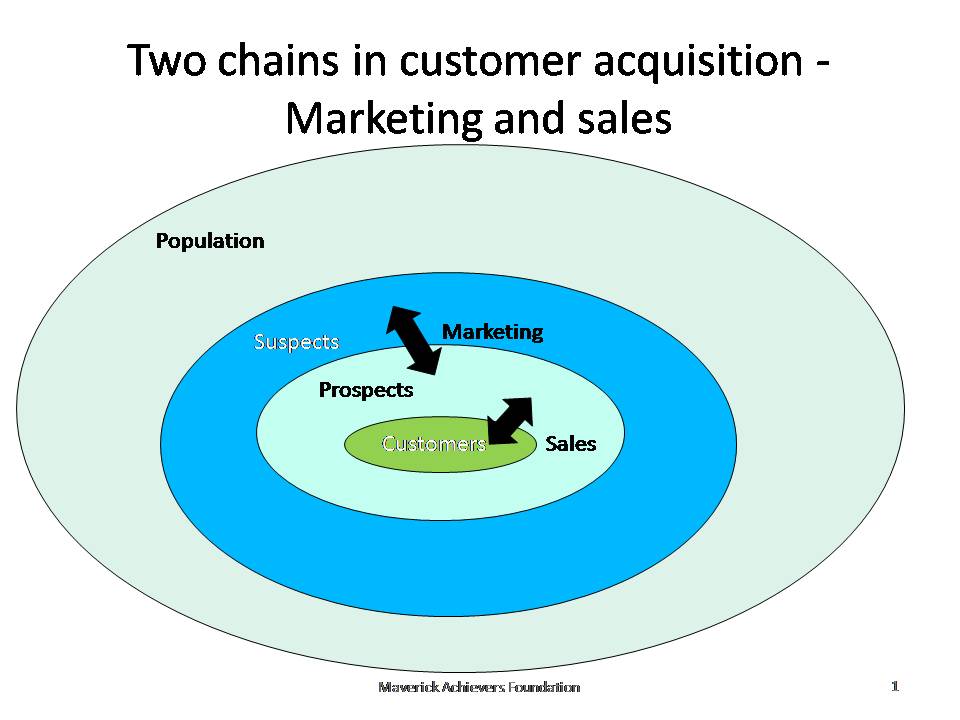
Two chains in customer acquisition loop

Many entrepreneurs overlook the fact that customer acquisition loop consists of two chains: Marketing (which converts suspects into prospects so that they come to the doorstep) and Sales ( which converts the prospects at the doorstep into a customer). Some entrepreneurs see these two conversions as one, and therefore take wrong actions.

Marketing chain

If Tata Motors is targeting families above incomes above 12 lakhs pa in the population, Tata motors will give  advertisements in the newspaper, sponsor programs for families, or put banner on the roads to convert these suspects ( the families of incomes above 12 Lpa) into prospects who want to buy Tata Manza. These 'marketing' activities allows an entrepreneur to convert their targeted suspects into a possible prospect. However, this marketing system has many holes. Because of these holes, unexpected events can suddenly happen and can break the cause>effect relationship. For instance, if the families of 12 Lpa do not happen to read the advertisement in newspaper for some reason,Tata Motors will not be able to get enough prospects after giving the advertisement.


Sales chain

Sales on the other hand has a relatively less transparent ( less holes) boundary. Because of this, an entrepreneur can predict the relationship between cause and effect with more assurance. Tata Motors, for instance, can hope to convert the prospect (  family of 12 lakhs per annum) into a customer with more assurance, because they can provide all the necessary information and assurance to the family once it comes in the showroom. The sales chain therefore is more 'predictable' than marketing chain.

New type of thinking required by entrepreneur

On the other hand, Customer servicing ( be it production, quality, and delivery) is even more predictable and controllable, because it is within the close confines of a factory or building. In customer servicing, for instance, an entrepreneur can take an action, see the reaction, and change the action  in next iteration. This environments are called short-feedback environments. They enable one to learn from the feedback and constantly improve. Short feedback environments are quick learning environments. Learning to play tennis and cook is easier because it is a short-feedback environment.

In contrast to customer servicing, the feedback time in sales environment is extended. One is therefore not sure 'which action has caused what consequence'. For instance, one is not sure why a prospect refused to buy Tata Manza, despite having enough money? Learning in such delayed-feedback environments is difficult because one needs a different type of cause>effect thinking.

In marketing environment, this feedback is even more confusing because 'more interactive variables' enter in the crucible. When less than expected prospects come to the showroom after the advertisement, one is not sure of the reason. Because such environments are delayed+ interactive variables-feedback environments. (In technical language, these are called messy situations.) One is not sure if 12 lpa families read the advertisement and disliked the features of Tata Manza? Or did they not read the advertisement at all? or did they get more attracted by a discount scheme of a competitor of Hyundai which was launched at the same time? Or was it a effect of a big accident of Tata Manza that happened a week before the advertisement? The interactiveness of various variable create a confusing picture and one is not sure of what is causing which consequence. This requires a different type of cause-effect thinking?

What does an entrepreneur need?

This different type of cause>effect thinking is called as Systems thinking. Systems thinking enables an entrepreneur to deal with marketing and sales environments that have indeterminate cause>effect correlations. Systems thinking is very useful to deal with such messy situations. It teaches them to carefully arrive at conclusions without oversimplifying. In influencing transparent system like marketing, it teaches them to coordinate many actions together to produce a output and not just hope that a banner will influence the customer. It helps them take decisions that are more 'accurate'. It helps them identify the risks they are taking so that they can take those risks consciously.

Without Systems thinking, an entrepreneur cannot decipher marketing environment and sales environment. One way to reduce the complexity is by relying on industrial products alone. If an entrepreneur sells  industrial products to few customers, which are limited in number, he can considerably reduce the complexity of marketing environment on the one hand, and manage the resultant minimised complexity of sales environment.

However, without using systems thinking, entrepreneurs often make mistakes in managing even this minimised complexity. For instance, they will increase the capacity to meet peak load of two customers ( who contribute 80% of the output), without worrying about the high cost of low capacity utilisation that will result when output reduces to normal or below normal levels of output. Or they will depend on one customer without getting any 'premium' for 'sacrificing' the flexibility. Or they will invest on the promises of the customers which will never come through.

Summary

Although marketing and sales environments requires an entrepreneur to learn 'systems thinking', an entrepreneur also needs to learn 'systems thinking' even to manage 'large scale' environment of customer servicing. Once the factory becomes large, the relation between cause> effect become thin and tenuous. They become messy situations. For instance, increasing the salary does not result in increased motivation? Or hiring professionals does not reduce the turf wars between production department and quality department? Or training employees do not lead to increased accountability? Or team performance is not proportional to individual competency?

In other words, once factories and operations become large, an entrepreneur needs systems thinking even to manage these internal environments !

As an entrepreneur what challenges are you facing? Have you learn the right type of thinking to deal with messy situations ?

Monday, August 20, 2012

Is your business model attractive ?

Last week, I met Arjun, a smart entrepreneur, working in a rural area.

Arjun is a second class science graduate who passed out in 2006. He joined a company in Nashik which designed and supplied water purification plants for industrial and domestic clients in urban towns to provide potable drinking water. He joined as a service Engineer who serviced these clients around Nashik. Because of the 'small' nature of the company, he got involved in everything: Selling it to client, designing a plant based on the quality of the input water, installing the plant at the client's site and then servicing the client after the delivery. 

Because of his extensive reach in rural area, in 2009, he started his own unit of designing water purification plants for rural clients, which his company was not willing to service. Today, in 2012, he has a base of 80 clients growing at a compounded rate of 25%, with an employee base of about 6 graduates. 

What was right about this business model which helped Arjun to stabilise his new company, with practically no upfront investment, in a span of 3 years? A business model  with its two interacting loops - investment loop and resource loop - together determines the attractiveness and the unique challenges it throws to an entrepreneur. 

Investment loop

Every business, be it running a running a mobile services company like Airtel, making and selling cars like Tata Motors, or running a company like Arjun's, primarily requires investment in two sides of a loop: To get a  new customer ( i.e Customer Acquisition) and To service that customer ( i.e. Customer Delivery and Servicing). Both sides of the loop are co-related. For instance, servicing a customer, if done well, generates lot of 'repeat' sales with an existing customer or more word-of-mouth customers, which in turn reduces the need of investing in the customer acquisition. 

When a new business is launched, an entrepreneur has to invest time and money to get new customers with a certain value proposition. For instance, Arjun's value proposition to his customer was " I will deliver you water purification plants at your location to convert your available water into potable water at the price of x". Sometimes you have to deliver higher value at higher price, or lower value at lower price. In other words, customers from different segments require different value proposition. 

But, once the customer is found, he has to be delivered the 'promised' value. If the promised value ( be it low or high) is delivered,  the customer is satisfied. Satisfied customers help you get more new customers either through word of mouth, direct referrals, or through endorsements. ( For instance, if a Sarpanch of a village installs a  waterpurification plant, that becomes an endorsement!) In Arjun's business, he also had to service the customer after delivery, because the water purification plant may need repairing and maintenance. This after-delivery servicing needs more investment but also enables one to generate a constant revenue stream. Many businesses like selling soaps and stationary, for instance, do not need this servicing. 

So when Arjun launched his business in 2009, he invested his time and money in getting new customers, but once he got them, he also had to invest in delivering and serving those customers. This is an investment loop which pulls entrepreneur's investment ( of time, money and resources) in two directions, often causing lot of agony for the entrepreneur. 

When a business starts, in the initial period, the proportion of investment between customer aquisition and customer servicing is say, 70:30. As the business matures, the proportion shifts to 50:50 and further to 30:70. Different businesses have different dynamics though. For instance, in a product like colas, the proportion may remain as high as 60:40 even after maturity. While in a water purification plant of Arjun it may shift to 30:70, as the old customers start bringing in new customers. In Industrial products, manufacturing ancillaries of Automobile or two wheelers, it may be as lopsided as 10:90.  In some businesses, huge investments may be required in both sides of the loop for a long long time. For instance, mobile service providers like Airtel and Uninor. Such businesses therefore make huge losses for a long time and must 'plan' for the losses !

For an entrepreneur to be successful quickly, investment loop has to be favourable. This means that the proportion of investment between customer acquisition and customer servicing should ideally shift from 70:30 to 30:70. (Please remember that 10:90 is not a favourable proposition, because it causes over-dependence on one customer. Witness the recession spiral in automobile ancillaries when automobile demand drops.) This is what happened in Arjun's case. With a small team, he naturally focused more on servicing existing customers. He was lucky to have no competition during this time. If he had competitors, his new customers would have been captured by them. But, as he had no competiton, he could wait for old customers to fetch him new customers. This time allowed him to deepen his skills and capabilities in Customer servicing, which in turn allowed him to get new customers. Once he started generating 'surplus' (not profit), he could then invest in increasing his team size, which in turn allowed him to spend more time and money in new customer acquisition. Now the investment loop was favourable for Arjun.

Resource loops

Arjun was also lucky to have another favourable loop: the loop of training new graduates>  retaining them once they are skilled to get returns from them. Many entrepreneurs suffer from this unfavourable resource loop. They get raw resources ( graduates), train them, and once they start delivering the revenue, these trained graduates leave because they get better compensation for their skills in the skill-market. In Arjun's case, this did not happen due to several reasons. One, skills required in his team were not of very high order. He could therefore hire new graduates and make them do 'routine' parts, and slowly learn the 'difficult' parts. Two, because there were not many competitors in water purification sector, these resources stayed with him for three years, which was enough for him to get his investment loop running. (This year, Arjun has lost one key trained resource!) Morever, as he picked up 'rural graduates', they tend to stick to 'known company', rather than find  another 'employer'.

Summary

In the initial period of starting a business unit, an entrepreneur has to be smart enough to make these two loops favourable for him: One is the Investment loop and another is the Resources loop. Almost all business models have unfavourable factors that make them less attractive; they have to be made attractive by the smart entrepreneur.

The investment loop may be unfavorable because of external factors: high competition for the same customers, or inability to reach customers at low cost because customer is fragmented, or because the investment required in servicing is too high or the customer payment cycle is too long. Or  it can be unfavorable due to internal factors such as inadequate resources even to do the basic work, insufficient investment even to accomplish one side of loop such as customer acquisition, and inability to understand the dynamics of the loop.

Similarly resources loop can be unfavorable because of external factors: competition in skill-market, alternative choices for the resources, time required to train the resource is too long. It is unfavorable due to internal factors: Inability to share revenues with key resources, inadequate understanding of how to do the training when the skill is difficult, or insufficient use of processes to manage the delivery ( thus making the delivery prone to many costly errors). More often than not, it is the resources loop which pull down the entrepreneur.

A smart entrepreneur intuitively understands the dynamics of these two loops to survive the initial difficult stages of an enterprise. If an entrepreneur fails to read these signals, no amount of intelligence and willpower can help him. If however, he is able to 'read these loops' in his business model, he not only can survive the initial growth pangs of a small company, but can grow the enterprise rapidly.

How is your business model?

Monday, July 23, 2012

Conserving Willpower is the most important skill for the entrepreneurs


If you see how your mental energy is dissipated in making small choices and avoiding distractions, you will appreciate that, for an entrepreneur, conserving willpower is a single most important skill that can make or mar his enterprise. This is especially true for service sector entrepreneurs, who can constantly change their offerings with little investment.

Manufacturing sector entrepreneurs at least are limited in their choices because of the fixed investment they make in machineries, but service sector entrepreneurs do not have this constraint. Service sector entrepreneurs include website developers, Software solution providers to shops and other small units, Software support units for small businesses like shops, doctors and schools, stock market service providers, hardware support maintenance units, training and coaching classes of different varieties. Even freelancers like trainers and researchers are also service sector entrepreneurs and therefore encounter the same challenges of these professionals.

No sooner one business offering stops producing intended result, say in three to six months, they start another one. With their mental energy consumption being the highest due to the constant choices they make, these entrepreneurs constantly err in taking these big decisions of altering business. Shifting from say conducting a class for diploma students to starting a coaching class for engineers is just a matter of printing another pamphlet for them. Or shifting from serving one class of customers ( say doctors) to serving another class of customers ( insurance agents) is just a matter of starting a sales campaign. They have very little mental energy to weigh the implications of their business models, evaluate the competition in another segment, or map the value addition that can be done in the delivery model.

For service sector entrepreneurs, such big decisions are simply a matter of 'braving it out' and 'hard work'. They simplify their choices by assuming 'one has to take risk to earn money'. They have little time to acknowledge that psychologists have discovered in their research that 'successful entrepreneurs are those who risk the least'. These entrepreneurs do not realise that their single most 'valuable resource' is their 'time'. And apportioning that time has to be done as diligently as apportioning money. Instead they will do multiple activities in a given 10 hour day and expect to produce result from multiple activities. For instance, i know of a talented freelancer who is engaged in three different business models simultaneously in a day: doing astrology ( being an engineer he is a first rate astrologer), doing journalism ( he has taken a degree in journalism) and also doing real estate deals. What result can you expect from these dissipated efforts?

Sometimes, due to inadequate willpower,  these entrepreneurs suffer a much more deeper imbalance between short term results and their deeper intentions. If they start earning money from 'x' activity which is however not tapping their deeper potential, they find it difficult to transition it to another 'y' activity which will actualise their potential better. This transition from x to y requires them to make multiple choices and stick to them for a long time. Unable to muster enough mental energy for doing so, they are unable to initiate the new activity which will help them fulfill their deeper potential. Slowly and surely life is drained from them, and they wonder why money is not giving them 'happiness'.  Although they became entrepreneurs ( or researchers or trainers) to develop their deeper potential, they end up suffering with the same illness: Enough money but with little satisfaction.

If you do not want to end with the same illness, you have to learn to conserve your Willpower !


Friday, June 15, 2012

Can you run your enterprise on excellence?

I was reading Vidhu Vinod Chopra's interview on his style of film-making. Please do not pay attention to his contrarian views, but listen to his style.

"Ferrari took us four years to write, 3 idiots took us 3 years" , Vinod Chopra said in his interview. He further added that 'Munnabhai MBBS III is in writing for last 3 1/2 years, but he is not willing to start it because the script has not yet come out well. Please remember that with Vinod Chopra's background, if he makes a film, he can collect 100 crores in first three-five days.  What makes Vinod Chopra work on excellence, when others run after money?

Take another example of Aamir Khan. Here is a man, who could have earned huge money, by doing more than one film at a time. But he refuses to do more than one film at a time, lets go opportunity to earn money in his 'hey days'. Film industry actors 'justify doing as many films as they can' because their shelf-life is short, as they say. But what makes Aamir Khan not worry about his shelf life, when other actors behave differently?

If you think that I am giving big celebrity examples only, let me give you a simple example of an entrepreneur. Let us call him Vikas. He is an entrepreneur in Nashik. Started his first unit supplying to Foundry manufacturer in early 1990's. Went through huge difficulty during recession. Now runs a unit of wire. Employees from 1990's are working with him still. ( Please remember that entrepreneurs find it difficult to retain good people !). Vikas follows highest standard guidelines of managing hazardous material called REACH. Has no target set for his unit, other than producing excellence. What makes entrepreneurs like Vikas practice excellence in business, where entrepreneurs do anything to justify 'business'?

What do you find common between Vinod Chopra, Aamir Khan and Vikas? They practice excellence, and believe that it will fetch them the desired revenue. For them, Money is means to end, not an end by itself. For them, money is a byproduct of what they do, not the end by itself. For them, doing something 'right' is more important than doing something 'ok', even if that ok is acceptable to the majority.

More importantly, they have one important quality. They are not impractical and unrealistic zealots who practice 'quality' for the sake of 'quality'. Instead they understand the constraints of their excellence and are willing to work with it. For instance, Vidhu Chopra knows it takes so long to make these films and is willing to live with that constraint. Even when he makes a movie like Eklavya, he knows that the audience is not ready for it and is willing to wait for it. Or Vikas is ready to work with limited customers to ensure that his quality is 'paid' the right value.

Like others, they do not blame people and customers for not 'paying' them enough for their quality. Instead they are contended and wait for the right opportunity to come. This ability to wait for the right opportunity separates them from the herd. Instead of chasing money and projects, they chase 'excellence'.

I know of many individuals who have managed to chase excellence without chasing money. Money just followed them. It requires a specific mind of mindset and a 'set of skills' to do it. Do you have it in you to chase excellence in your field?